
What should parents be doing every day with their toddlers? If you have asked this question before, here are some developmentally appropriate suggestions for how to set up your daily play with a two-year-old girl.
Por dónde empezar
Si tienes una niñita en este rango de edad, podrías estar considerando empezar la guardería con ellas. Son curiosas y brillantes con tantas preguntas. Parecen listas para aprender sus letras y números, pero si realmente lo has intentado, probablemente encontrarás que un minuto saben qué es la A y al siguiente no. Si intentas que se queden quietas, terminan debajo de su silla o rodando por el suelo. Aunque es tentador empezar la guardería a esta edad, yo esperaría hasta que sus cerebros y cuerpos estén listos para procesar y retener la información que quieres que aprendan. Entonces, ¿qué deberíamos hacer con estas niñitas que parecen tan ansiosas por aprender?
If you have both girls and boys, you might already be aware of the vast differences between the species. Little boys in general seem determined to try to jump off the tallest rocks and you spend an astronomical amount of your time keeping them from injuring themselves, but they also seem almost proud of their injuries. Little girls can be just as active and energetic, or not, but seem to actually care about injuring themselves. At 2, both genders seem to delight in making giant messes, running around in circles and creating absolute chaos, but testosterone is already surging through little boys at this age causing them to seek additional adrenaline experiences. This isn’t to say all boys, or all girls, are the same. There are vast differences in temperament, personality and family dynamics, but I will write a separate blog for boys of this age because their needs usually are different than girls.
What should 2-year-old girls be doing every day, if not early academics?
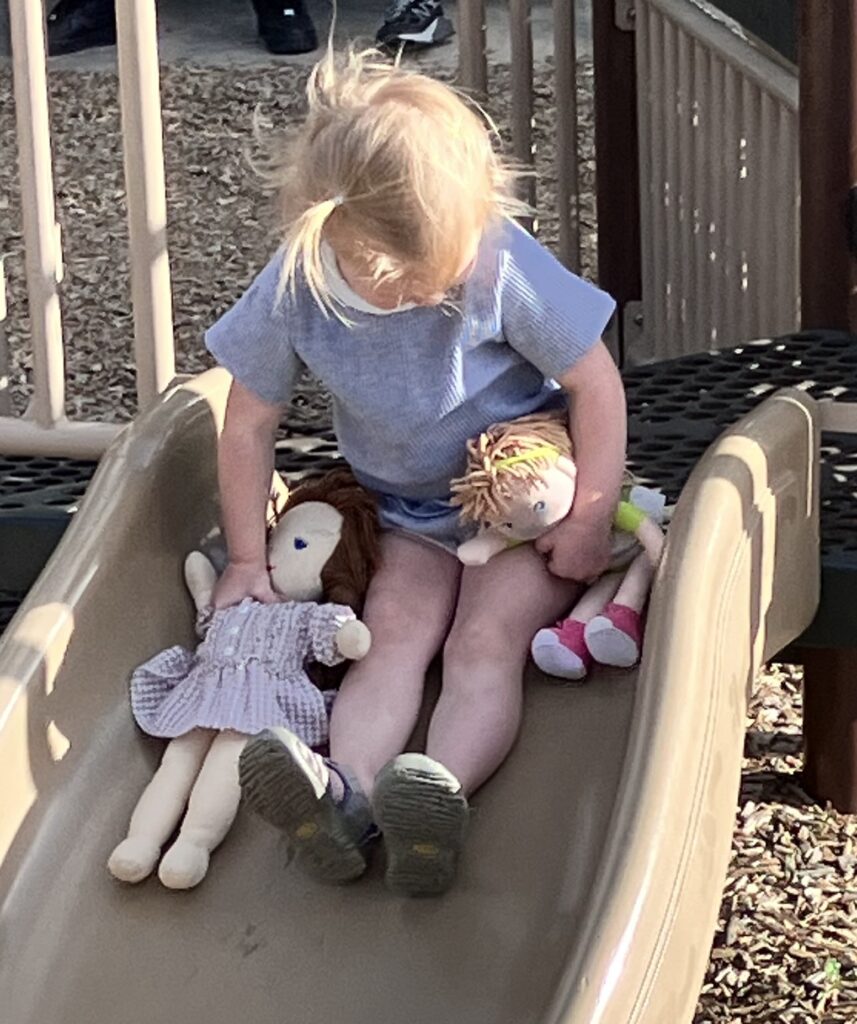
First, and foremost, children this age need several hours a day of outside time or movement play. Even if they are playing in the sand or drawing with chalk outside, that still counts because the feel of the sun on their face, the sound of birds chirping, and the smell of grass are still engaging their senses in ways that being indoors does not. Ideally, girls should be spending over an hour outside in the morning and in the afternoon. If not able to be outside, the time should be made up of indoor movement play that uses their whole body. If a child does not get these hours a day of either outside or movement time, they will show it at bedtime.
The second most important element of your schedule for this age group of girls is being around other children their own age. Aim for about 5 hours a week around other children from 1 to 5 years of age. This can be at the park, or an indoor play place, and can also count towards your outside or movement time. Even if your child has siblings, it is important for girls this age to still spend time around other children to develop language, social, and emotional skills. Making friendships is also an important developmental step for this age and seeing the same children on a regular basis is the best way to help your child make friends. Friendships allow children to practice their relationship skills and executive functioning skills. These are things like sharing, take turns, cooperative play, conversational skills, and having empathy for another child.
Creación de Espacios Exteriores para Niños Pequeños
Movement Play for Young Children
The third most important element is sensory play. Two- and three-year-olds are still integrating their senses and this needs to happen before their brains will be ready for formalized learning. This should look like two or three 20-minute sessions of play dough, kinetic sand (if 3), dried beans, water play, or even helping you bake and playing with the dough. This would also include playing with instruments, playing with kid-safe flashlights in a tent, or driving toy cars along a toy road. Sensory play should rotate between texture, sound, balance and visual experiences.
The fourth element of a child’s day at this age should be open-ended art time. This should be separate than sensory play or outside/movement play. This would include drawing with large crayons, markers, finger paints, dot markers, shaving cream, large foam stickers, and large butcher paper or construction paper. This should be messy and I recommend a designated spot for this play. This art time should be all about the process and should not be geared towards any end product. This is also about sensory integration, fine motor skills, hand-eye coordination, and cause and effect. Art smocks are also helpful.
Building Blocks for Learning
There are some other elements that you can start to incorporate into your schedule as your child shows that they are ready for them. These are building blocks towards pre-academics. They develop executive function skills like focus, turn taking, and patience. Some girls will be ready for all of these things at 2 ½, while others may not be ready till closer to 3 ½.
The first is structured art projects with an end product. This is where you introduce smaller crayons, smaller markers, paint brushes, colored pencils, watercolors, kid scissors, and glue sticks. The fine motor skills needed to use smaller crayons and markers, paint brushes, and scissors don’t usually develop until closer to age 3. Before that age, children may also struggle with the sequence of steps needed to use these tools. Once your child is ready, you can replace two of your open art sessions a week with structured art sessions. These should be heavily parent led and supervised at first as your child learns new skills, but over time this should evolve into creating art projects together. For context, my oldest daughter was exactly 3 when she was ready for this and I used a child’s craft book for inspiration.
The last category is game time. This is when your child is ready to follow simple rules with game boards or cards. Pick games that you can adapt so there is no clear winner. Games like Duck, Duck, Goose or tag are great around this age. Games that involve taking turns and minor disappointments are also good to introduce. Look for game boards that are recommended for ages 3 or 4. You may have to adapt them though. This is a great time to also introduce real puzzles that you and your child do together. This would replace some of your sensory play sessions. For context, my oldest daughter was 2 and 9 months old when she was ready for this, but we started with just 10 minutes a few times a week.
Here is an example of what a daily schedule might look like for a 2-year-old girl.
Horario de ejemplo
- 7:00 am Despertarse
- 7:30 am Desayuno
- 8:00 am Juego sensorial o Tiempo de juego/puzles
- 8:30 am Open Art Time or Structured Art Time
- 9:00 am Snack Time
- 9:30 am Tiempo al aire libre/Movimiento/Socialización
- 12:00 pm Almuerzo
- 12:30 pm Nap Time
- 3:00 pm Snack time
- 3:30 pm Outside/Movement/Socialization time
- 5:30 pm Dinner time
- 6:00 pm Sensory play
- 7:00 pm Bedtime
Leave a Reply